

A kettle earns its counter space in a small kitchen faster than almost any other appliance. It boils water for coffee, tea, instant noodles, oatmeal, and a hot-water bottle on a cold night, all without lighting a stove. The problem is that the kettle built for a family kitchen is often the wrong kettle for a studio or a dorm room: too tall for the cabinet above, loud enough to wake a roommate, or heavy enough when full that you dread lifting it. Here is what actually matters when the kitchen is the size of a doormat and the person boiling water is sitting three feet away.
Capacity: Start With Your Mug, Not the Box
Manufacturers count cups in teacups, not in the mug you actually drink from. A generous mug holds around 300 ml, so a kettle labelled "two cups" may fill exactly one mug with a little left for steam. Measure your favourite mug with a measuring jug once and you will never be fooled again.
- 0.5–0.6 L: one person, one or two mugs at a time. Small enough to live in a cabinet, boils in roughly two minutes, and stays easy to pour when full.
- 0.8–1.0 L: the sweet spot for one or two people. Enough for a French press plus a top-up, and usually short enough to sit under a wall cabinet.
- 1.2 L and up: only worth the space if you brew for two or more several times a day. A full 1.7 L kettle weighs roughly 3.7 pounds, and the base it sits on takes up real horizontal room.
Measure the Counter, the Cabinet, and the Outlet
Three measurements prevent most returns. First, the height from your counter to the underside of the upper cabinet, with the lid closed — many compact jugs run 7 to 9 inches tall, and a tall lid knob adds another inch. Second, the footprint of the power base, which is often wider than the kettle body itself; a cordless jug needs somewhere to park that base permanently. Third, the distance to the nearest wall outlet, because a short cord plus a crowded counter is how kettles end up balanced on the edge of a sink.
Shape matters as much as size. Gooseneck kettles pour with lovely control for pour-over coffee, but the long spout and wide base eat horizontal space, which is the scarcest thing in a micro-kitchen. If your counter is barely bigger than a cutting board, a tall narrow jug with a cord that wraps around the base will store and travel better. Check that the handle is on the side you find natural, especially if you will pour with your left hand.
Where Kettle Noise Actually Comes From
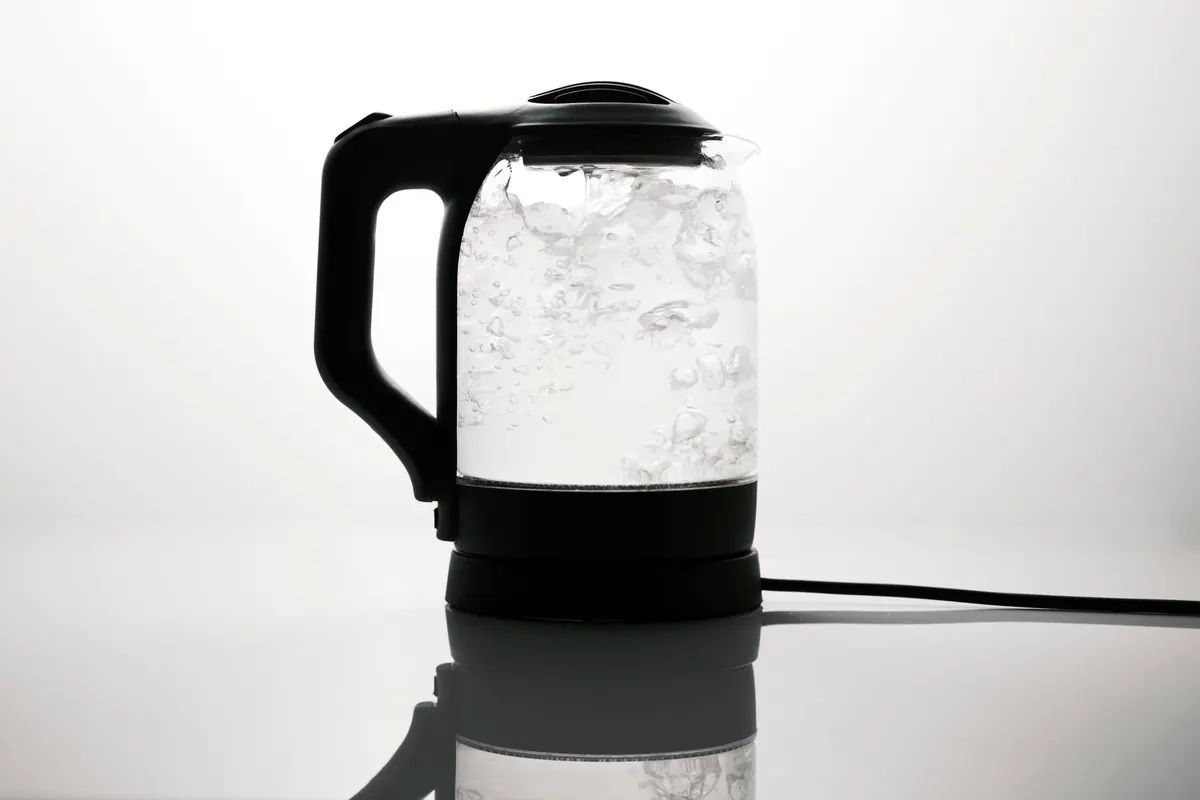
Kettle noise has three sources: the element heating the water, the rush of bubbles as it approaches a boil, and the lid or body vibrating against the base. You can influence all three.
What to look for
- A flat, concealed heating element rather than an exposed coil, which tends to be gentler and is much easier to descale.
- A lid that seats snugly, ideally with a silicone seal. A rattling plastic lid is often the loudest part of the boil.
- A double-wall or insulated body. These muff le the rattle noticeably and keep water hot longer, so you may not need a second boil.
- A weighted base with rubber feet, which keeps the whole unit from buzzing across the counter.
Cheap tricks that work
Set the kettle on a folded towel or a rubber mat rather than directly on a hollow counter or a metal tray, both of which amplify sound. Never fill past the maximum line; water spitting through the spout is noisy and slightly risky. And if you mainly drink green or white tea, heating to 80°C instead of a rolling boil skips the loudest final minute entirely.
Keep in mind that "quiet" in product copy is relative. If noise is your deciding factor and you cannot hear a model in person, buy from a shop with a straightforward return policy.
Temperature Settings Are Worth It for Tea and Pour-Over
A basic kettle has one job: boil. A variable-temperature kettle lets you choose, which matters more than most people expect. Green tea generally wants roughly 70–80°C, oolong and white tea around 80–90°C, and black tea, herbal blends and French press close to 95–100°C. Pour-over coffee is usually best just off the boil. Presets get you there in one tap; a dial or plus-minus buttons give finer control if you are chasing a particular brew.
A keep-warm function is convenient if you sip slowly through the morning, but it draws power, so unplug the kettle when you leave the room. If you are preparing formula for a baby, follow the manufacturer's instructions and ask your pediatrician about safe water temperature and preparation rather than trusting a preset.
Dorm Rooms Have Their Own Rules
Housing policies come first. Many residence halls restrict or ban kettles in bedrooms, and some require automatic shut-off, a sealed heating element, or a cord under a set length. Ask your resident advisor or housing office before you order; a confiscated kettle is money wasted, and the rules exist because dorm circuits are shared.
On that note, plug a kettle directly into a wall outlet. These appliances draw a lot of power, often well over 1000 watts, and stacking one on a power strip shared with a mini-fridge or a hair dryer is a good way to trip a breaker or overheat a cheap extension cord. Never leave a kettle running unattended, keep it away from bedding, curtains and paper, and let it cool before you pack it into a drawer. Insist on both auto shut-off and boil-dry protection.
A 60-Second Buying Checklist
- Capacity matched to the number of mugs you fill at once.
- Height and base footprint checked against your actual counter.
- Concealed element, snug lid, and double-wall body if quiet matters.
- Variable temperature if you drink green tea or brew pour-over.
- Auto shut-off and boil-dry protection, always.
- Cord wrap, plus a cord long enough for your outlet.
- A lid that opens wide enough to fit your hand inside for cleaning.
- A clear water window with readable minimum and maximum marks.
Keeping a Small Kettle in Good Shape
Scale is the enemy of a compact kettle. It slows the boil, makes the element work harder, adds noise, and eventually flakes into your tea. If your water is hard, descale every four to eight weeks: fill halfway with equal parts white vinegar and water, bring it to a boil, let it stand for fifteen to twenty minutes, then boil fresh water twice and pour it away. Citric acid works the same way if you dislike the smell. Wipe the outside with a damp cloth, but never immerse the base, cord or plug.
Empty the kettle after each use and leave the lid open to dry, since standing water speeds up scale and can leave a stale taste. Store it with the cord wrapped loosely, not kinked tight around the base.
Choose capacity first, then check height and footprint against your real counter, then decide whether quiet boiling or temperature control earns the extra dollars. Get those three in the right order and a kettle that fits on a shelf the size of a shoebox will still feel like a full-size kitchen appliance.
Photo: Engin Akyurt / Pexels
Related posts
More stories you’ll love reading